Parish Rooms and Pay-What-You-Can: Notes From a Village Hall Tour
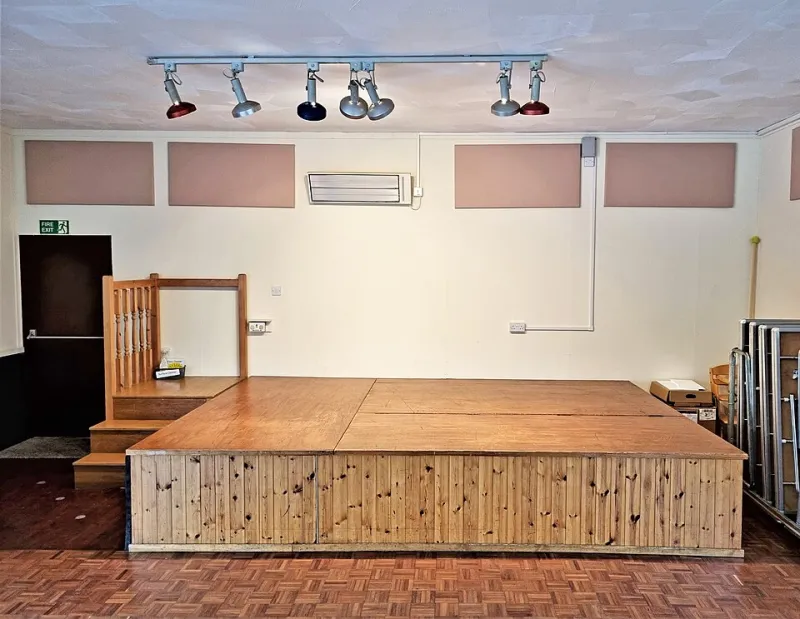
Photo: Little Kazakh Alien, CC BY-SA 4.0, via Wikimedia Commons
Last month I loaded a show into a parish room in a village whose main features are a war memorial, a Spar and a hall with a stage that is technically three rostra and a curtain on a wire. I've done four of these this year. Not out of purism, and not because I've fallen out with anybody in a city, but because a black box studio in town costs roughly what a village hall costs for a fortnight — and the audience is very often better behaved.
Something is shifting. With touring budgets in 2026 doing that thing where it gets smaller every time you look at it, the village hall has quietly become one of the most interesting rooms in the country. Not as a compromise. As a venue.
The room that smells of floor polish and squash court
You know the smell. Beeswax, faintly chlorinated, and somewhere a urn. You know the acoustics too: a high ceiling and a hard floor, which turns a whispered line into a pub quiz announcement and makes a cello sound like it's being played in a swimming pool.
But here's the thing nobody tells you when you're starting out. A black box theatre is designed for people who already go to the theatre. A village hall is designed for people who go to the village hall. That's a completely different, and much larger, kind of audience.
My first scratch night in a hall this spring, the front row was three teenagers, a man in a Regatta fleece who I later discovered was the parish clerk, and a woman called Doreen who had brought her own cushion. Doreen laughed in places I didn't know were funny. She also told me afterwards, with enormous kindness, that the second half 'wanted a bit of a tighten'. She was right. I tightened it.
What the black box gave us, and what it cost
I'm not here to bury the studio theatre. It taught me precision. It taught me that a lighting state can be a punchline. It gave me a rake, a proper wing, and a sound desk that didn't have a 'karaoke' setting.
What it also gave me was a hire invoice and a pressure to fill 90 seats to break even, which meant I spent more time on the marketing than on the show. In a hall, the economics are gentler. Somewhere between £15 and £25 an hour is normal; a full day might be £140. You can do a pay-what-you-can bucket at the door and still come out ahead on a Tuesday.
The trade-off is that you become the entire technical department. Which brings me to the useful part.
The practical bit: a checklist before you book anything
- Ask about the power before you fall in love with the room. Most halls have a ring main and a fuse board in a cupboard that says 'DO NOT'. Some have a stage lighting bar with four sockets. Ask for a photo of the fuse board. Nobody has ever regretted this.
- Ring the caretaker, not the booking secretary. The booking secretary knows the calendar. The caretaker knows that the wall socket by the piano clicks off when the urn is on.
- Assume no blackout. Village halls have beautiful, enormous, un-coverable windows. If your show needs darkness, bring blackout fabric and a staple gun, and get permission in writing.
- Bring your own everything. Two small LED pars, a stand, a mini PA or a decent acoustic amp, gaffer tape, a torch, a spare extension reel, and a four-way adapter. You will use all of it. Usually in the first twenty minutes.
- Check the get-in. Double doors or a fire exit with a lip? Is there a ramp? Can you park outside for fifteen minutes or is the car park locked at six?
- Rostra are never level, and the floor is never flat. Mark your spike marks in pencil, not tape, unless you fancy a conversation with a committee about adhesive residue.
- Licensing. If you're playing recorded music, the hall may not hold the right licence — ask, and factor in PRS/PPL. Selling alcohol usually needs a Temporary Event Notice. A raffle needs a small lottery registration from the local authority. Bake sales need nothing but courage.
- Insurance and safety. Public liability cover, PAT testing certificates for anything you plug in, and a written risk assessment. Hall committees are volunteers and they will love you for arriving with paperwork already done.
- Accessibility. Counter-intuitively, village halls often have better accessible toilets than converted city warehouses. Check step-free entry, and ask whether there's a hearing loop. Usually there isn't, so consider surtitles or a printed script.
Building an audience when there's no box office
This is the bit that takes actual work, and it's also the bit I've grown to enjoy most.
The parish magazine goes to print around the tenth of the month — miss it and you've missed a month. The village Facebook group is more powerful than any listing site, but it will also discuss your show's parking arrangements at length. The library, the bowls club, the school gate and the free paper all still work. And there are proper rural touring schemes out there doing the hard yards of matchmaking between shows and halls; if you're serious about this, they're worth the application form.
One tactic that has never failed me: price the tickets so that bringing a friend is almost free. 'Two for the price of one and a bit' fills rows faster than any poster.
The committee is your co-producer
Within an hour of arriving, somebody will offer you tea and ask what you need. Say yes to both, and be specific. The person who runs the hall is often the person who runs the village, and if they like you they will become your press officer, your front of house, your interval caterer and your most honest critic, all for the price of a box of biscuits.
At one hall this autumn, the WI ran a traybake stall in the interval and my raffle takings beat my merch table by a factor of three. I have made my peace with this.
Why it's worth the drive
The black box taught me to be precise. The village hall taught me to be warm. One is a room built for the work; the other is a room built for people, which then has to be persuaded to hold the work. That persuasion — the tea, the posters, the borrowed curtain, the man in the fleece who turns out to be a superb lighting operator — is the whole job, and it's the reason I keep pointing the Fiesta at another postcode.
If you're sitting on a show and can't afford the studio, take it to a hall. Do the paperwork. Ring the caretaker. Bring a spare extension reel. And if Doreen tells you the second half wants a tighten, listen to her.