Seven Scribbles, One Sketchbook: What My Messiest Pages Actually Taught Me
Photo: Francesco Lorenzi, CC0, via Wikimedia Commons
I keep a sketchbook the way other people keep a compost bin. Things go in, nothing looks edible for months, and then something unexpected grows out of the side of it.
Mine is not the sort you photograph for Instagram. It's a cheap A5 hardback from a stationery shop near the bus station, and it contains drawings so bad that a life-drawing tutor once gently suggested I 'focus on the words'. She was right. What I've learned since is that the words and the scribbles do the same job: they let an idea exist badly for long enough to get better.
Here are seven pages from the current book. All of them are messy. All of them earned their place.
Scribble one: the chair with forty arrows
Early on there's a drawing of a single chair, annotated with roughly forty arrows. Arrow to the leg: 'too thin?' Arrow to the seat: 'sag?' Arrow to nothing in particular: 'spike marks??'. It is the work of someone who would rather plan a show than make one.
The lesson: design is not making. At some point the arrows stop being useful and become a very tidy way of not doing the work. My rule now is three questions per drawing, maximum, then straight to the making — even if the making is a cardboard mock-up taped together on a kitchen floor in Sheffield.
Scribble two: 'THIS IS BORING', in biro, underlined twice
Halfway down a page of notes for a spoken-word piece, in handwriting that looks like it was done on a moving bus because it was, are three words: this is boring. I remember writing them. I remember the exact sag of my shoulders.
The lesson: the honest note is the useful note. It's very easy to get a group of supportive friends to say 'lovely' about a draft. It's much harder to say 'this is boring', and much more valuable. Now I do a read-aloud test at the point where I'm most attached to a piece, and I write my reaction in the margin before anyone else can be polite at me.
Scribble three: a genuinely terrible drawing of my own hand
There are, conservatively, two hundred of these. Each one worse than the last. But the page next to them has a note: 'quantity has a quality all of its own'.
The lesson: ugly drafts are not waste. For every decent idea I've had, there are twenty bad ones in the same notebook, and the bad ones do useful work — they keep the pen moving, they warm up the eye, they make the good one less frightening to start. Nobody's grading the sketchbook. That's the entire point of the sketchbook.
Scribble four: overheard lines, written down on a train to Leeds
'Well, I'm not saying she's a bad person, I'm saying she's a bad parking person.' 'Do you want the big coat or the coat that makes you look like a vicar?' 'It's not a dog, it's a lifestyle.'
The lesson: noticing is a skill, and it needs somewhere to land. Half the characters I've written in the last few years started as a stranger's half-sentence. Carry something to write on that isn't your phone. The phone makes you look like you're ignoring people; the notebook makes you look eccentric, which in a train carriage is basically a free pass.
Scribble five: a good idea crossed out, then taped back in
At the back of the book there's a page I tore out in frustration and sellotaped back in about a month later. The idea in the middle of it is now the whole second half of a show.
The lesson: 'not now' is not 'no'. Most of what gets rejected in a bad mood deserved a better mood. I now date everything, which sounds like admin but is actually mercy — future me can look back and see that the idea was killed on a Tuesday after a difficult phone call, not on merit.
Scribble six: a coffee ring over a set design
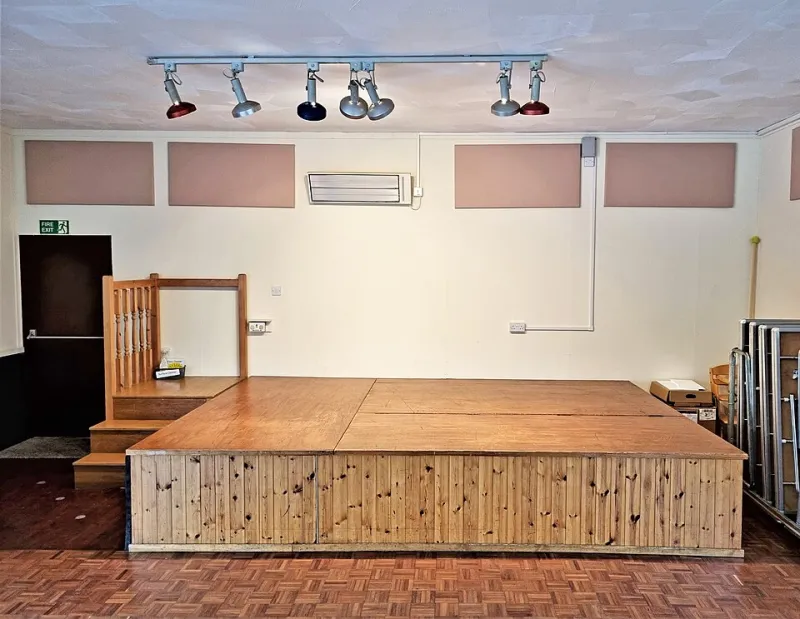
A proper, full, brown circle across a pencil plan for a small stage. I'd been about to redraw the whole page cleanly. Then I noticed that the stain made a shape I liked more than the drawing underneath.
The lesson: leave room for the accident. Not everything in a rehearsal room or a studio should be pre-decided, because the best moments tend to arrive sideways — a prop that falls over, a line that gets mangled into something funnier, a lighting state that happens because someone bumped the desk. The job is to make a space where an accident can survive a second viewing.
Scribble seven: a box drawn round the word 'WHO?'
Bottom of a page, entirely on its own, in a box, underlined until the pen went through the paper.
The lesson: have an actual person in mind. Not 'an audience'. Not 'people who like this sort of thing'. A person. Mine, for one piece, was a friend's dad called Keith who works in logistics and has never been to the theatre voluntarily in his life. Every time the work got too clever, I'd imagine Keith's face and take something out. The show got shorter and better.
The book is the workshop, not the shop window
The thing I wish someone had told me earlier is that a sketchbook isn't a finished object. It's a floor to drop things on. The polished portfolio — the neat grid of finished work, the tidied captions, the good lighting — is a completely different item, and confusing the two is the fastest way to stop making anything interesting.
So: keep the bad drawings. Write the rude notes. Let the coffee land where it lands. And if you see me on a train with a biro and a scruffy notebook, mind your volume — you might end up in a show.