Pencil Price Tags and Honest Questions: A Christmas Fair Stall Diary
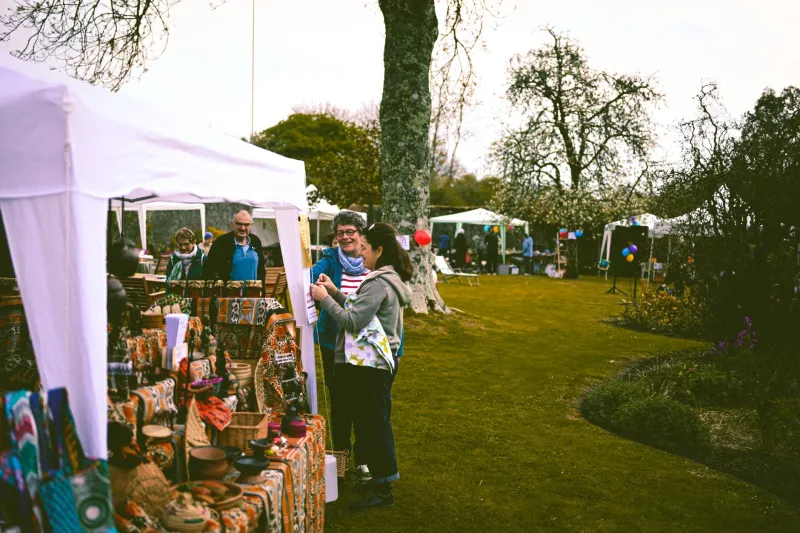
The trestle table was wobbling. I had a box of prints, a jar of pencils, and a card reader that only worked if I held it near the window. Next to me, the tombola had already drawn a queue. This year I finally said yes to a table at the church hall Christmas fair. I thought I was there to sell work. I was actually there to learn how work looks when it is sitting on a folded tablecloth under a fluorescent strip light, with a mince pie in one hand and a five-pound note in the other.
The table is not the work
Online, my shop is a series of rectangles on a screen. I can crop the world out. In a church hall, the world comes with the work: the draught from the fire doors, the smell of the urn, the bunting that keeps dipping into the raffle prizes. The first thing I learned is that display is not decoration. It is translation.
A print lying flat on a table reads like a receipt. A print propped up on a box, with a bit of space around it, reads like a present. I spent the first hour rearranging. I put the smaller cards in a shallow tray so people could flip through them without asking. I raised the bigger pieces on a folding crate covered with a plain cloth. I moved the price list to the front. I stopped saying “feel free to have a look” and started saying “you can pick them up.” People did.
The church hall has no spotlight and no algorithm. It has a strip light and a draught. So I kept it simple: one tablecloth, two heights, three clear groups of work. The mince pies were on the other side of the room. That was probably for the best.
Pencil price tags and the handmade tax
I wrote my price tags in pencil because I changed my mind three times before the doors opened. Online, I can hide behind postage and packaging. In person, someone picks up a lino print, turns it over, and asks why it is eighteen pounds. You have to answer out loud. That is not a bad thing.
My answer got shorter as the day went on. “It is a lino print. I cut the block, I print them by hand, and the ink takes a while to dry.” That was usually enough. A few people wanted the whole process. A few wanted to tell me about their nephew who does pottery. Both are fine. The trick is to answer the question you were asked and then stop. A price is not an apology.
I used round numbers. Three pounds for a card, eight for a small print, fifteen for a medium one, twenty-two for the framed piece. No fifty-pence increments. The church hall is a cash economy with a card reader for emergencies. I had a float of coins and a small tin for notes. By midday the tin had a satisfying weight and I had said “sorry, I have got a five” more times than I would like to admit.
The handmade tax is real, though. People want to know that the thing in their hand took time. They want to know it is not a download with a frame around it. The pencil tags helped. They looked like working notes, not a shop. One woman said, “It is nice to see the price written by a human.” I did not tell her I had rewritten them four times.
The small talk syllabus
A craft fair is a conversation with a finish line. You have four hours to talk to a hundred people and none of them owe you a sale. The questions arrive in a predictable order. Did you make this? How long does it take? Is this your job? Do you do commissions? Have you been here before? Do you know where the loo is?
I got better at the first answer. “Yes, I made all of it” is a dead end. “Yes, the prints are mine and the cards are from the same blocks” gives them somewhere to go. I got worse at the last one. I sent three people to the kitchen when they wanted the cloakroom.
The small talk is not a distraction from the selling. It is the selling. People buy from people they have spoken to, even if the conversation was about the weather and the tombola. A woman bought a card because the colour matched her kitchen. A man asked if I had a print of the bus station. I said no. He said, “You should.” I wrote it down on the back of a price tag. That is market research, church hall style.
What the tombola knows that the algorithm does not
My online shop is very polite. It waits. It shows me numbers. It never tells me that the light in the room is wrong or that my cards are too low down for anyone over six foot. The church hall is not polite. It is honest. People pick things up and put them down. They say “that is a bit dear” within earshot. They ask what your real job is. They buy a raffle ticket and forget your table.
The tombola has a queue because it is simple. Pay a pound, get a chance, take a prize. Nobody needs a returns policy. Nobody asks about postage. I am not saying creative work should be a tombola. I am saying the church hall strips away the things I hide behind online. There is no funnel. There is a table, a person, and a room full of neighbours who have already spent money on mince pies.
It is a tougher marketplace in some ways. The prices are lower, the room is colder, and half the people are there for the raffle. But it is more honest. You find out which piece catches an eye from three metres away. You find out what happens when you say the price out loud. You find out that selling is a conversation, not a conversion rate.
I packed up at four o'clock with a nearly empty box and a pocket full of change. I had not made a fortune. I had made enough to cover the table, the printing, and a mince pie. Next year I will bring a better tablecloth and a longer extension lead. I will keep the pencil.