Cold Hands, Loose Tinsel: What My First Christmas Lights Gig Taught Me About Civic Theatre
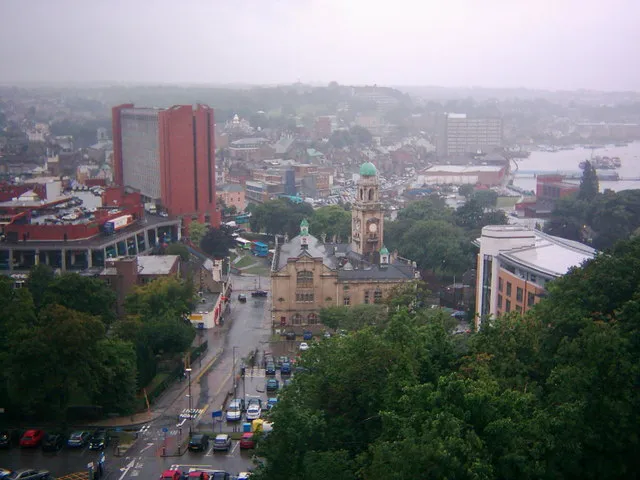
Photo: Lisa Fulcher, CC BY-SA 2.0, via Wikimedia Commons
The brief was gloriously simple: a twenty-minute set on the town-centre stage, just before the big switch-on. The reality involved a borrowed brolly, a generator that sounded like a sulking leaf blower, and a compere who introduced me as 'Owen, from the arts'. I have never been described so accurately and so ominously in the same breath.
It was my first Christmas lights switch-on. I had done pub gigs, village halls and one memorably damp shopfront show, but nothing quite like this. A high street is not a theatre. It has no foyer, no bar, no interval and absolutely no expectation that anyone will sit still for longer than it takes to finish a mince pie. That turned out to be the useful bit.
The gig starts long before the set
I arrived two hours early, which felt excessive and was actually just about right. The stage was a trailer with a gazebo bolted to it. The sound desk was being guarded by a man called Keith who had the calm of someone who had seen every possible cable failure and had decided not to be surprised by any of them. The local choir were warming up behind the tombola. Father Christmas was due on a traction engine at four. The Rotary Club raffle had a table of prizes that included a hamper, a bottle of something brown and a voucher for a shoe shop that closed in 2019.
Civic organisers are a specific breed. They are not venue programmers. They are volunteers, council staff and people who have given up their Saturday to make the town look like it cares. They do not need me to be precious. They need me to know my start time, stick to it and not ask for anything that requires a forklift. So I asked three questions: where do I plug in, who cues me, and what happens if the generator dies? The answers were 'over there', 'I do' and 'we pray'. Honest, at least.
Holding a crowd of shoppers
A shopping crowd is not an audience. It is a river with bags. People are moving, stopping, checking phones, telling children to keep hold of the buggy. You cannot demand their attention. You have to give them a reason to pause.
The trick, I learned, is not to fight the interruptions. The raffle is not a distraction from the show; it is part of the show. The choir is not competition; it is a change of texture. The countdown is not an inconvenience; it is the climax. If you treat the whole afternoon as one loose piece of civic theatre, you stop feeling like you are performing between things and start feeling like you are performing with them.
I opened with something short and loud enough to reach the back of the crowd, then brought it down. I learned names. I asked who had come from the estate up the hill and who was only there because the bus was late. I made a joke about the weather being 'cold, probably wet' and got the first real laugh. Then I did the set I had planned, but looser. When the generator coughed during the third piece, I kept going and let the choir hum behind me. It was not planned. It was better than planned.
Make the low budget look like a choice
Low-budget festive theatre can smell of desperation if you let it. The trick is to make the constraints visible and intentional. A borrowed brolly is a prop. A plastic chair is a throne if you treat it like one. A faulty generator is a running gag if you get there first.
I had a small bag of tinsel and a torch. I used the torch as a footlight. I wrapped the tinsel around the mic stand and told the crowd it was 'the budget light rig'. People laughed because it was true. That is the thing about civic gigs: the audience is on your side before you start. They want the town to feel good. They want the lights to come on. They want the choir to be in tune, or at least enthusiastic. Your job is not to impress them with polish. Your job is to hold the space long enough for the switch-on to land.
What I packed, and what I wish I had packed
The forecast said 'cold, probably wet', which is the most British sentence ever written. I packed a waterproof notebook, gaffer tape, spare batteries, a flask of tea, fingerless gloves, a towel, a bin bag for the kit and a change of socks. I wished I had packed a second change of socks, a headtorch and a small tin of sweets for the volunteers. I also wished I had printed the running order in a plastic wallet instead of trusting my phone in the rain.
If you are doing one of these, here is the short list: layers you can move in, a proper coat, a torch, tape, a flask, a towel, a plastic wallet for your notes, and a willingness to be flexible. Leave the ego at home. Bring the good socks.
The bit after the lights go on
By the time the countdown finished, I was cold, damp and weirdly proud. The lights came on. The choir sang. The raffle winner collected a hamper the size of a small dog. Keith unplugged something and looked relieved. I stood at the side of the stage with a paper cup of tea and watched the town do its thing.
It was not a West End show. It was not meant to be. It was a high street in December, with a faulty generator and a borrowed brolly and a crowd that had stopped for ten minutes because something was happening. That is enough. More than enough, actually. It belonged to the town, and for a short while, I got to be part of it.