Taped, Torn, Rescued: One Show Poster’s Life After the Curtain
The show closed on a Saturday night in late September 2026. Two performances, one borrowed lighting rig, and a dressing room that smelled faintly of someone else’s interval coffee. By the following Monday, the set was back in the van and the cast had gone home. But the posters were still out there.
I know because I spent a week in early November following them around a small town in the East Midlands. Not in a stalkerish way. More in the way you might retrace a paper round. I had printed 120 A3 sheets and 200 A4 sheets for a show called The Borrowed Light, and I wanted to know what happened to them after the last ticket was torn.
What I found was a second, accidental run. A quieter one, played to café windows, library noticeboards, bus shelters and one bedroom wall.
The first wave: café windows and the curling corner
The first poster I spotted after the run was in the window of a café on the high street. It had been up since the first week of September. One corner had curled forward like it was trying to look casual. The owner, Margaret, had stuck it behind the till rather than in the bin because, in her words, ‘the colours go with the menu board.’
That is not a marketing strategy. It is a small act of hospitality. But it told me something useful: a poster that survives is often one that behaves well in a room it was never designed for. Mine was A3, portrait, with a dark blue background and a single warm yellow rectangle. It looked like a book cover that had wandered into a café. Margaret liked it. I liked that she liked it.
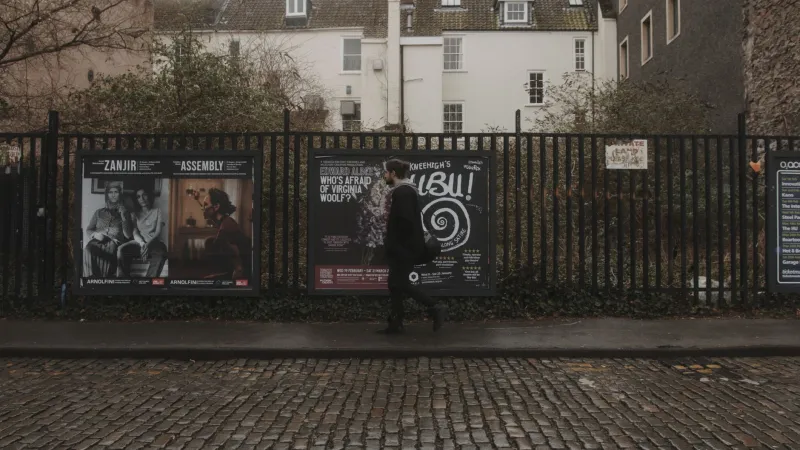
Further along the street, one poster had been taped to a lamppost and then rained on so many times that the date had gone soft at the edges. Someone had written ‘LAST WEEK!’ in biro across the bottom, which was both wrong and oddly hopeful. Another was in the window of a launderette, next to a notice about a missing cat. The cat had been missing since August. The poster had been up since September. Both had the same energy: please notice me.
The ones that get rescued
The strangest part of the trail was the skip. Outside the arts centre, the day after load-out, someone had binned a bundle of posters that never made it onto a wall. I fished one out. It was fine. Slightly bent, but fine. A teenager called Rhys saw me do it and asked if he could have another for his bedroom. He said the image looked like a record sleeve. I gave him three.
A poster in a bedroom is not a failed poster. It is a second audience. It is also a reminder that production art has a life beyond its original job description. The date might be wrong by November, but the shape, the colours and the name still do something. They say: this happened here, and someone made it.
At the library, the noticeboard copy had been neatly amended by a member of staff. The original date was crossed out and ‘SORRY — MISSED IT’ was written underneath in pencil. At the bus shelter, someone had drawn a moustache on the main figure. At the community centre, the poster had been laminated and kept up because the caretaker liked the typography. I am not making that up. He asked me if I had any more.
What the trail taught me about making under your own name
When your name is on the poster, the poster is a handshake. It is the first bit of the work that most people meet. Not the show, not the sketchbook, not the long explanation you give at a party. The paper.
That means it has to work in bad conditions. It has to work when it is curling, when it is behind glass, when it is half-covered by a takeaway menu, and when someone is looking at it from the top deck of a bus. If it only works as a tidy image on a screen, it is not really a poster. It is a thumbnail with ambitions.
It also means the afterlife matters. A poster that gets kept, rescued or re-used is doing quiet work for you long after the run. It is saying your name in a room you are not in. That is worth designing for.
Practical notes for a poster that deserves a second life
Give it one clear job. One image, one title, one date block. If the eye has to choose between three ideas, it will choose the bin.
Read it at three metres and at three inches. From across the street, the title and date should land. Up close, the small print should not be a punishment. If the venue name is only legible when you are touching the glass, it is too small.
Keep the date in one block. Do not scatter day, time and ticket link across four corners. People scan. Make scanning easy.
Leave a margin. Posters get taped, stapled, hole-punched and trimmed. A generous border is not wasted space; it is survival gear.
Credit the maker. A small line saying ‘Poster by [name]’ or ‘Design by [name]’ costs nothing and gives the object a bit of dignity. It also helps when someone wants to ask who made it.
Print fewer, better. I would rather have 80 posters on decent stock than 300 on paper so thin it turns to confession under rain. Fewer also means you can place them properly instead of carpet-bombing the parish noticeboard.
Do not rely on a QR code alone. QR codes are useful, but they are not a personality. Put the essential words on the sheet. A poster should still work when the code is scratched, rained on or ignored.
Ask where it will live. Will it be behind glass? In a bus shelter? On a bedroom wall? That changes the colours, the size and the finish. A poster for a wet UK autumn needs to accept that it will get wet.
Make the back worth reading. A tiny line of text, a sketch, a print run number, a thank-you to the venue. It gives the thing a reason to be kept rather than recycled immediately.
The last poster I saw
On my final afternoon following the trail, I found one in the window of a launderette two streets back from the high street. It had been there since September. The owner said she had left it up because it made the place look busy. The date was long gone, but the title was still clear. The yellow rectangle was still doing its job.
The show lasted two nights. The poster is still working. That feels like the right ratio for a small piece of work made under your own name: brief on stage, slower on paper, still saying something to someone who never bought a ticket.